
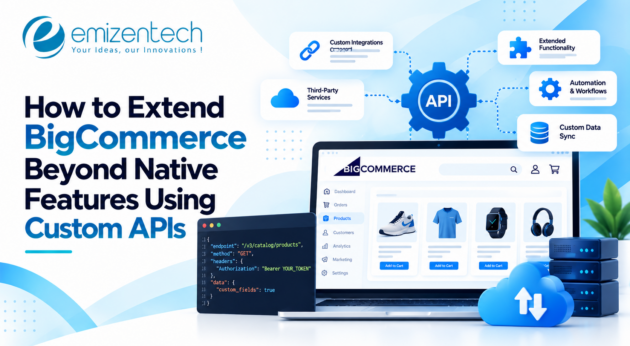
BigCommerce provides core ecommerce capabilities for managing products, processing orders, accepting payments, and operating an online storefront. However, businesses with complex workflows often need functionality that standard features cannot fully support. These requirements may include customer-specific pricing, automated ERP synchronization, multi-warehouse inventory management, and custom order processing.
Custom APIs allow BigCommerce to communicate with external applications, exchange data, and execute business-specific operations. Instead of relying on manual processes or disconnected systems, businesses can build integrations that align their ecommerce platform with existing operational workflows. A well-planned BigCommerce development strategy helps extend platform capabilities while maintaining a scalable and manageable architecture.
The first step is identifying the operational gap that needs to be addressed. Adding custom functionality without understanding the underlying problem can increase development costs and create unnecessary dependencies.
For example, a B2B merchant may need different prices for individual customer accounts based on negotiated contracts. A retailer operating multiple warehouses may need inventory updates to flow between BigCommerce and its warehouse management system. An enterprise business may also need to transfer orders into a legacy ERP that does not support a ready-made connector.
Evaluate native features, marketplace applications, and existing integrations before developing a custom solution. Custom APIs are most valuable when these options cannot satisfy specific requirements for data exchange, business rules, or automation.
BigCommerce provides APIs for administrative operations, storefront experiences, and event-driven integrations. Choosing the right interfaces is an important part of BigCommerce development, as it helps ensure reliable data exchange and supports the required store functionality.
Consider an inventory integration. Webhooks can notify an external service when a relevant order event occurs, while Management APIs can support the required inventory operations. A scheduled reconciliation process can compare records and identify missed updates.
Effective BigCommerce development focuses on selecting the APIs needed to support specific business workflows rather than integrating every available interface.
Custom APIs are particularly useful when ecommerce operations depend on several applications or specialized business rules.
ERP and accounting integration: Transfer order information, product data, and relevant financial records between BigCommerce and enterprise systems. This reduces duplicate entry and helps maintain consistent operational records.
Multi-warehouse inventory synchronization: Exchange stock quantities with warehouse systems, account for reserved inventory, and coordinate stock updates across locations. This helps reduce overselling and fulfillment errors.
Customer-specific pricing: Connect external pricing engines or business systems to support approved pricing rules based on customer contracts, purchasing conditions, or other requirements.
Order management automation: Send orders to external systems for validation, allocation, fulfillment, and shipment processing. The integration can also return supported status updates to connected applications.
Custom storefront functionality: Retrieve data from external services to support specialized product experiences, business-specific search, or personalized content.
Each use case should have a measurable objective, such as reducing manual order entry, improving inventory accuracy, or shortening processing time.
A custom API integration must define how information moves between systems and which system controls each data type.
For example, an ERP may be the authoritative source for product prices, while BigCommerce manages the online catalog and customer orders. The integration should specify when price updates are transmitted, how failed updates are retried, and how conflicting records are resolved.
For businesses connecting several applications, middleware can provide a centralized integration layer. It can transform data formats, apply business rules, queue operations, and manage communication between systems.
During BigCommerce development, engineers should also account for API rate limits, request timeouts, partial failures, and duplicate events. Idempotent processing is particularly important: if the same event is received twice, the integration should not apply the same business action twice.
This architecture reduces inconsistencies and makes the integration easier to troubleshoot as transaction volumes increase.
A structured implementation process reduces technical risk and makes the solution easier to maintain.
For example, an order integration should be tested from the moment an order is created through external processing and the return of relevant status updates. Testing only individual API requests will not reveal every workflow-level problem.
Custom APIs can expose important business records if credentials or permissions are poorly managed. Security should therefore be built into the integration architecture.
Use least-privilege permissions, store credentials securely on the server, and never expose access tokens in browser code or public repositories. Validate incoming data and verify webhook authenticity using the supported verification process.
Sensitive information should not be unnecessarily stored in application logs. Businesses should also establish credential rotation procedures, monitor suspicious activity, and revoke access when integrations are retired.
These controls help reduce unauthorized access risks while allowing connected systems to exchange information safely.
An integration is not complete when it goes live. It needs monitoring to identify errors before they affect inventory accuracy, order processing, or customer experience.
Track API response failures, processing delays, webhook delivery problems, and discrepancies between connected systems. Configure alerts for repeated failures and maintain logs that show when events were received, processed, and completed.
Use scheduled reconciliation for critical data such as inventory and order status. If an update fails, the system should retry safely and flag unresolved discrepancies rather than silently accepting incorrect information.
Regular testing and maintenance are also necessary when API requirements, connected applications, or business workflows change.
Custom API development is appropriate when standard features and available applications cannot support essential business requirements. It can also be valuable when manual processes become expensive, integration failures occur frequently, or disconnected systems prevent teams from accessing consistent information.
For example, a growing retailer may need a proprietary ERP integration with custom inventory rules, while a B2B business may require specialized pricing and order approval workflows. EmizenTech provides BigCommerce development services for businesses seeking tailored integrations, API-driven functionality, and ecommerce workflows aligned with their operational needs.
The scope should be defined around specific business outcomes, technical dependencies, and ongoing maintenance requirements rather than adding complexity without a clear purpose.
Custom APIs help businesses extend BigCommerce beyond its native capabilities by connecting external systems, automating complex operations, and supporting specialized customer experiences. Successful implementation depends on selecting appropriate APIs, defining data ownership, building secure integration workflows, and monitoring performance after deployment.
A structured BigCommerce development strategy enables businesses to reduce manual work, improve data consistency, and adapt ecommerce operations to changing requirements. By focusing on measurable business needs and reliable integration design, organizations can extend their platform without creating unnecessary technical complexity.
October 22, 2026 - December 31, 2026
08:30 AM
United States
#HowtoExtendBigCommerceBeyondNativeF...





Kompster is a directory and marketplace for competitions, races, challenges & championships.
We're building the World's Largest Repository of Competitions, right here on the web. Join us!
Browse Competitions or List an EventKompster.com - The World of Competition
