
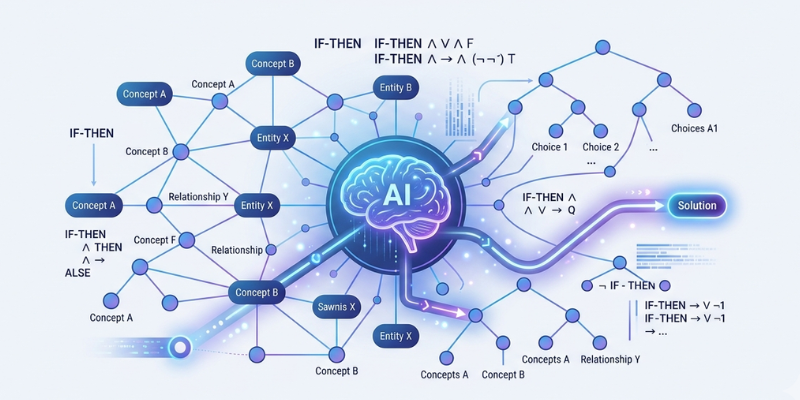
Artificial Intelligence (AI) helps machines process information, understand patterns, and solve problems that usually require human intelligence. To achieve this, AI systems need ways to represent knowledge and use it to make decisions. Knowledge representation helps machines organize information, while problem-solving techniques guide them toward suitable solutions. Understanding these concepts is essential for anyone exploring modern AI technologies. If you want to build a strong foundation in generative AI, consider exploring Gen AI Courses in Chennai at FITA Academy to develop your knowledge of AI concepts and their practical applications.
What is Knowledge Representation in Artificial Intelligence?
Knowledge representation is the process of storing information in a structured format that an AI system can understand and use. It allows machines to work with facts, relationships, rules, and concepts instead of treating information as unrelated data.
For example, an AI system designed to recommend movies might store information about movie genres, actors, and user preferences. It can use these relationships to suggest films that match a person’s interests.
Common knowledge representation methods include logical statements, semantic networks, knowledge graphs, and rule-based systems. Each method helps AI organize information for different types of tasks.
Common Methods of Knowledge Representation
AI systems use several methods to represent knowledge, depending on the problem they need to solve.
1. Logical Representation
Logical representation uses facts and rules to describe information. An AI system can apply these rules to reach conclusions.
For example, if a system knows that all birds have certain biological characteristics and that a sparrow is a bird, it can use this information to draw relevant conclusions about sparrows.
2. Semantic Networks
Semantic networks represent knowledge through connected concepts. Each concept forms a node, while the connections describe relationships between concepts.
For instance, a semantic network can connect a dog to the category of animals and associate dogs with characteristics such as having four legs. This structure helps AI understand how different concepts relate to one another.
3. Knowledge Graphs
Knowledge graphs organize information as entities and relationships. They are useful for connecting large amounts of information across different sources.
Search engines, recommendation systems, and question-answering applications can use knowledge graphs to identify relationships and provide relevant results.
4. Rule-Based Representation
Rule-based systems use predefined conditions to determine what action to take. These rules often follow an if-then structure.
For example, a troubleshooting system might suggest checking the battery if a device does not turn on. This approach works well when the problem can be addressed through clear rules.
How AI Systems Solve Problems
AI problem-solving involves identifying a goal, examining available information, and selecting actions that can lead to a solution.
First, the system defines the problem and identifies the possible starting conditions. Next, it explores available actions and considers their potential outcomes. It then selects a suitable path toward the goal.
Search algorithms play an important role in this process. Breadth-first search explores possible solutions level by level, while depth-first search explores one path before moving to another. A* search uses additional information to identify promising paths efficiently.
For example, a navigation system can examine different routes between two locations and select one based on distance, traffic, or travel time.
The Role of Reasoning in AI Problem-Solving
Reasoning allows AI systems to use available knowledge to reach conclusions or make decisions. Deductive reasoning applies general rules to specific situations, while inductive reasoning identifies patterns from observations.
AI systems may also use probabilistic reasoning when information is incomplete or uncertain. For example, a medical support system might consider symptoms and available evidence to estimate the likelihood of different conditions.
Combining knowledge representation with reasoning helps AI systems move beyond storing information. It enables them to interpret relationships, evaluate possible outcomes, and make more informed decisions.
Challenges in Knowledge Representation and Problem-Solving
Representing knowledge accurately can be difficult when information is incomplete, inconsistent, or constantly changing. AI systems must also handle ambiguity and uncertainty when interpreting real-world situations.
Another challenge is computational complexity. Some problems involve so many possible actions that examining every option becomes impractical. Efficient search algorithms, good representations, and suitable reasoning methods help reduce this difficulty.
Modern AI systems may combine symbolic methods with machine learning to handle structured rules and complex patterns. This combination can improve problem-solving across a wider range of applications.
Knowledge representation and problem-solving are fundamental concepts in Artificial Intelligence. Knowledge representation helps machines organize facts and relationships, while reasoning and search algorithms help them find solutions. Together, these techniques support applications such as navigation, recommendation systems, expert systems, and intelligent assistants. If you want to strengthen your technical understanding and explore practical AI applications, consider enrolling in an Artificial Intelligence Course in Chennai to build your skills and advance your AI learning journey.
Also check: Building a Future-Ready Career with Generative AI Skills


