
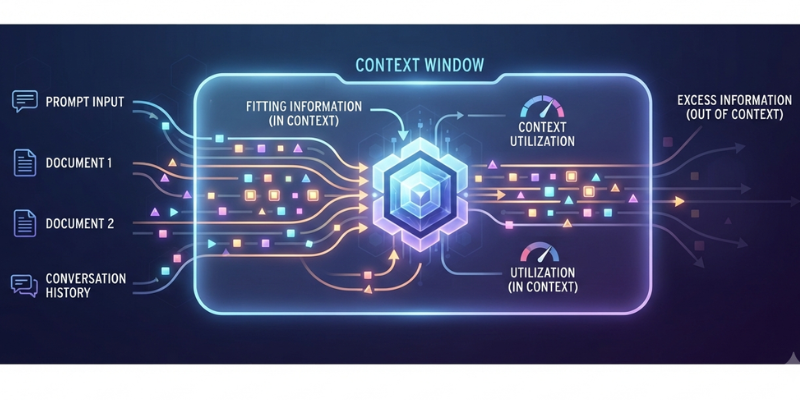
Large Language Models, or LLMs, can process and generate human-like text, but they cannot consider an unlimited amount of information at once. The amount of information a model can handle during a single interaction is known as its context window. Understanding this concept is important for anyone learning how modern Generative AI systems work. If you want to build a strong foundation in this field, you can enroll in Generative AI Training in Hyderabad at FITA Academy to learn more about these concepts in a structured way.
What is a Context Window
A context window refers to the largest quantity of information that an AI model can handle at a single moment. This information can include the user’s prompt, previous messages, documents, instructions, and other text provided to the model.
Language models do not process text exactly as humans read it. They divide text into smaller units called tokens. Model has a context window of 100,000 tokens, it can consider up to that amount of tokenized information within a particular interaction. The exact amount that can be A token can represent a complete word, part of a word, punctuation, or another small piece of text. The context window is therefore commonly measured in tokens rather than words.
For example, if an AI model has a context window of 100,000 tokens, it can consider up to that amount of tokenized information within a particular interaction. The exact amount that can be used for your response may depend on how the model and application manage the available space.
Why Context Windows Matter
Context windows are important because they determine how much information an LLM can consider when generating an answer. A larger context window can allow a model to work with longer documents, extended conversations, and larger collections of related information.
Consider a user who provides a lengthy business report and asks the model to summarize it. If the entire report fits within the available context window, the model can process the provided content together. If the content exceeds the limit, some information may need to be removed, divided into sections, or processed separately.
This limitation becomes particularly important when building AI applications. Developers need to decide how much information should be sent to a model and which information is most relevant to the current task.
How Context Windows Work With Tokens
Before an LLM processes text, the text is converted into tokens. The model then uses those tokens as part of its input context. The generated response also consumes tokens from the available capacity, depending on the model and its configuration.
This means that a context window is not simply a limit on the number of words in a prompt. A long document, previous conversation messages, system instructions, and the expected response can all contribute to the overall token usage.
Understanding tokens helps users create more efficient prompts. Instead of providing large amounts of unrelated information, users can focus on the details that directly support the task.
Context Windows and Long Conversations
Context windows play a major role in conversations with AI assistants. As a conversation becomes longer, more previous messages may need to fit within the available context.
When a conversation becomes too large, an application may use techniques such as summarization, information retrieval, or selective message history. These techniques help the system retain important information without sending every previous message to the model.
This is particularly advantageous for customer service systems, research aides, and AI applications that require handling information throughout prolonged interactions.
Context Windows in RAG Applications
Retrieval Augmented Generation, commonly called RAG, is another area where context windows are important. Instead of sending an entire knowledge base to an LLM, a RAG system retrieves information that is relevant to a user’s question.
The selected information is then added to the model’s context. This approach helps the model focus on useful content while avoiding unnecessary information.
Good retrieval is therefore important. Sending too much irrelevant information can consume valuable context space and may make it harder for the model to focus on the most useful details. If you want to develop practical knowledge of these AI concepts, you can take a Generative AI Course in Ahmedabad to build your understanding through structured learning.
Challenges of Limited Context Windows
A limited context window can create several challenges. Important information may need to be shortened or removed when a conversation or document becomes too large. This can affect the model’s ability to maintain continuity across long interactions.
Another challenge is that simply increasing the context size does not automatically guarantee better results. Models still need to identify relevant information and use it effectively. Poorly organized or repetitive input can reduce the usefulness of a large context.
For this reason, effective AI applications often combine context management with techniques such as summarization, retrieval, chunking, and prompt optimization.
Context Windows and the Future of Generative AI
Context windows have become an important part of Generative AI because AI applications increasingly work with long documents, large datasets, and extended conversations. Larger context capabilities can make it easier for models to handle complex tasks involving substantial amounts of information.
However, context size is only one factor in an AI model’s performance. The quality of the model, relevance of the information, prompt design, retrieval methods, and evaluation process also influence the final result.
Understanding context windows gives beginners a clearer picture of how LLMs process information and why managing context is essential when creating reliable AI applications. If you want to continue developing your Generative AI knowledge, join a Generative AI Course in Kolkata and explore these concepts in greater depth.


