
Deep learning has transformed artificial intelligence by helping machines recognize images, understand language, and solve complex problems. Nonetheless, developing a deep learning model from the ground up typically demands extensive datasets, robust computing resources, and considerable time investment. Transfer learning provides a viable approach by enabling models to apply knowledge acquired from earlier tasks. This approach makes AI development faster, more affordable, and more accessible for beginners and businesses. If you want to build a strong foundation in modern AI technologies, explore the Generative AI Course in Vellore at FITA Academy to develop relevant skills and understand how these techniques work in real-world applications.
What is Transfer Learning in Deep Learning?
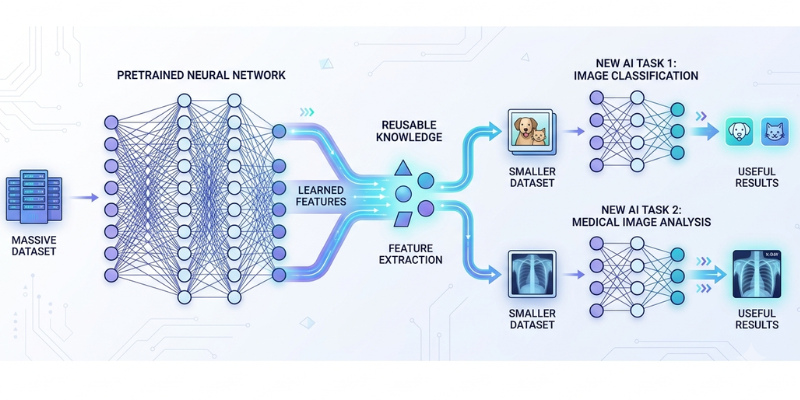
Transfer learning is a methodology in machine learning that leverages insights gained from a model that has already been trained to address a new, yet similar, challenge. Instead of teaching a model everything from the beginning, developers start with a model that has already learned useful patterns from existing data.
For example, a model trained to recognize thousands of everyday objects may already understand shapes, edges, colors, and textures. Developers can adapt this model to identify specific products or medical images. Since the model already understands basic visual patterns, it needs less training to perform the new task.
How Does Transfer Learning Work?
Transfer learning typically begins with a pretrained model. This model has already learned important features from a large dataset. Developers then adapt it to a specific task using a smaller, task-related dataset.
There are two common approaches. The first is feature extraction, where developers use the pretrained model to identify useful patterns while keeping most of its learned parameters unchanged. A new output layer is added to handle the target task.
The second approach is fine-tuning. In this method, developers train some or all of the pretrained model’s parameters on new data. This helps the model adjust its existing knowledge to the specific requirements of the task.
Why Does Transfer Learning Make Deep Learning More Efficient?
1. Reduces Training Time
Training deep learning models from scratch can take hours, days, or even longer, depending on the model and dataset. Transfer learning reduces this effort because the model has already learned many useful features. Developers can often achieve good results with fewer training steps.
2. Requires Less Training Data
Deep learning models usually perform better when they have access to large amounts of high-quality data. Nonetheless, gathering and annotating data can be costly and require a significant amount of time. Transfer learning helps overcome this challenge by using knowledge from an existing model, making it useful when only a small dataset is available.
3. Lowers Computational Costs
Training large neural networks requires substantial computing resources. Transfer learning can reduce the processing power needed to develop a new application. This makes advanced AI techniques more practical for students, startups, researchers, and smaller organizations.
4. Improves Model Performance
A pretrained model already contains useful representations learned from previous examples. When the new task is related to its original training task, these representations can help the model achieve better results than training from scratch with limited data.
Real-World Applications of Transfer Learning
Transfer learning is widely useful across different areas of artificial intelligence. In healthcare, pretrained models can be adapted to assist with medical image classification. In retail, they can help identify products and detect visual similarities. In natural language processing, pretrained language models can be adapted for sentiment analysis, document classification, and customer support.
Transfer learning also supports generative AI applications. Developers can fine-tune pretrained models for specialized writing tasks, domain-specific language, and other targeted requirements. However, the quality of the results depends on the training data, the model architecture, and how well the original and new tasks are related.
Challenges and Limitations of Transfer Learning
Although transfer learning offers several benefits, it does not guarantee better results in every situation. If the original training data differs greatly from the new dataset, the transferred knowledge may not be useful. This problem is known as negative transfer.
Developers must also select a suitable pretrained model and ensure that the new training data represents the target problem. Fine-tuning can still require significant computing resources, especially when working with large models. Careful evaluation is therefore essential to confirm that the adapted model performs reliably.
Transfer learning makes deep learning more efficient by reducing training time, lowering computational costs, and helping models learn from smaller datasets. It allows developers to build on existing knowledge instead of starting every project from scratch. As AI continues to advance, understanding transfer learning is becoming increasingly valuable for anyone interested in machine learning and modern AI applications. If you want to strengthen your understanding of these concepts and explore practical AI applications, consider enrolling in an Artificial Intelligence Course in Vellore to build your technical knowledge and develop skills for future opportunities.


