
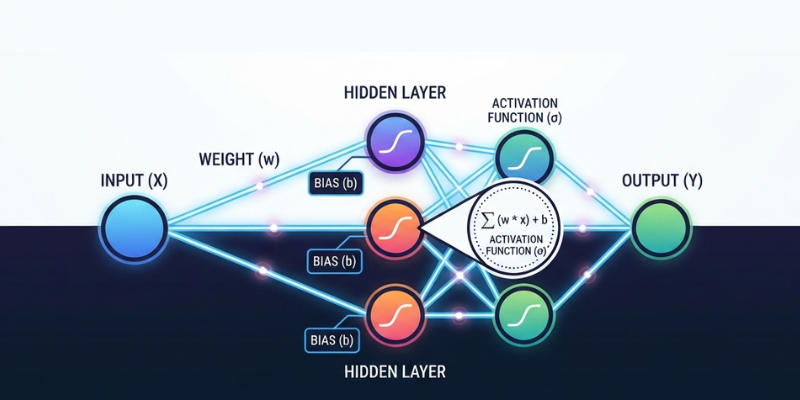
Artificial neural networks are one of the most important technologies behind modern artificial intelligence. They help machines identify patterns, make predictions, classify information, and solve complex problems. To understand how neural networks learn, it is important to know about three fundamental concepts: weights, biases, and activation functions. These elements work together to transform input data into useful outputs. If you are beginning your AI learning journey, enroll in an Artificial Intelligence Course in Chennai at FITA Academy to build a stronger understanding of these fundamental concepts and develop practical AI skills.
What Are Weights in a Neural Network?
Weights determine how important each input is when a neural network processes information. Every connection between neurons has a weight associated with it. During training, the network adjusts these values to improve its predictions.
For example, imagine a model that predicts whether a student will pass an examination. Study hours, attendance, and previous scores could be used as inputs. The model may assign different weights to these inputs because some factors may have a greater influence on the final prediction.
A higher weight means that an input has a stronger influence on the result. A lower weight means that its influence is smaller. The learning process involves continuously adjusting these weights based on errors made by the model.
Understanding Biases
Bias is another important value used by neural networks. It allows a neuron to adjust its output independently of the input values. You can think of bias as an additional value that gives the model more flexibility when making decisions.
Without bias, a neural network may have difficulty fitting certain patterns in the data. By adding bias, the network can shift its output and represent more complex relationships.
During training, both weights and biases are adjusted. The model compares its prediction with the expected result and uses the difference to improve these values. This process allows the network to gradually become better at its task.
What Are Activation Functions?
An activation function determines whether and how strongly a neuron should respond to its input. It is applied after the weighted inputs and bias have been combined.
Activation functions are important because they introduce nonlinearity into a neural network. Without this property, even a network with many layers would have limited ability to learn complicated relationships.
Some commonly used activation functions include ReLU, sigmoid, and tanh. ReLU is widely used in many deep learning models because it is simple and works effectively for many tasks. Sigmoid can produce values between zero and one, while tanh produces values between negative one and one.
How Weights, Biases, and Activation Functions Work Together
These three components work as a team. First, the neural network receives input values. Every input is multiplied by its related weight. The results are then combined with the bias.
The combined value is passed through an activation function. The resulting output becomes the input for another neuron or contributes to the final prediction.
This process happens across multiple neurons and layers. During training, the network identifies errors in its predictions and updates its weights and biases. Over many training cycles, these adjustments help the network learn useful patterns from the training data.
Why These Concepts Matter in AI
Understanding weights, biases, and activation functions provides a foundation for learning more advanced artificial intelligence concepts. These ideas are central to neural networks and deep learning systems used for image recognition, language processing, recommendation systems, and many other applications.
Once you understand how these components interact, concepts such as backpropagation, gradient descent, and model training become easier to understand. If you want to strengthen your practical knowledge, take an Artificial Intelligence Course in Bangalore to explore neural networks, machine learning algorithms, and other essential AI concepts in greater depth.
Weights, Biases, and Activation Functions in Deep Learning
Deep learning models typically contain many layers of interconnected neurons. Each layer can learn different patterns from the information it receives. Earlier layers may identify simpler patterns, while deeper layers can combine those patterns to recognize more complex features.
Weights determine the influence of information flowing through these connections. Biases help adjust neuron outputs, while activation functions allow the network to learn nonlinear relationships. Together, these elements give deep learning models the ability to handle complex problems.
Weights, biases, and activation functions are fundamental building blocks of neural networks. Weights control the importance of inputs, biases provide additional flexibility, and activation functions help neural networks learn complex patterns.
Understanding these concepts is an important first step toward learning machine learning and deep learning. With this foundation, you can more easily explore how neural networks are trained and how modern AI applications work. If you are ready to expand your AI knowledge and gain practical skills, join the Artificial Intelligence Course in Hyderabad to continue learning these concepts through structured training and hands-on practice.