
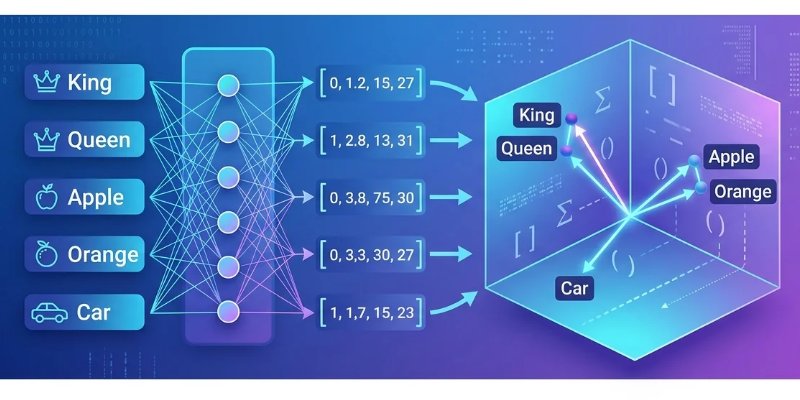
Human language contains words with different meanings, relationships, and contexts. However, computers cannot naturally understand words in the same way humans do. They need a numerical representation to process and interpret text. This is where word embeddings and vector representations become important. They help artificial intelligence systems understand the meaning of words and identify relationships between them. These concepts play a major role in Natural Language Processing (NLP), machine learning, and Generative AI. If you want to build a strong foundation in these technologies, consider enrolling in a Generative AI Course in Delhi at FITA Academy to develop practical knowledge and explore real-world AI applications.
What Are Word Embeddings?
Word embeddings are mathematical representations of words that encapsulate their meanings and associations. Instead of treating each word as a simple text value, word embeddings convert words into numerical vectors. These vectors contain information about the context in which words appear and how they relate to other words.
For example, words such as “king” and “queen” have related meanings, while “apple” and “orange” belong to a similar category. Word embeddings help machine learning models identify these relationships by representing words in a mathematical space. This allows computers to process language more effectively and understand similarities between different words.
Understanding Vector Representations
A vector representation is a collection of numerical values used to describe a word, sentence, or other data element. In NLP, each word is represented by a vector containing multiple numbers. These numbers capture different patterns and relationships learned during model training.
Words with similar meanings often have vectors that are closer to each other in the embedding space. For example, the vectors for “car” and “vehicle” may have a stronger similarity than the vectors for “car” and “banana.”
These numerical formats simplify the process for AI systems to carry out functions like text classification, semantic search, language translation, and answering questions.
How Do Word Embeddings Work?
Word embeddings are created by training machine learning models on large collections of text. During training, models analyze how words appear together and identify patterns in their surrounding context.
For instance, consider the sentences “The dog is playing in the garden” and “The cat is playing in the garden.” The model can identify that “dog” and “cat” appear in similar contexts. Over time, it learns to represent these words using vectors with related characteristics.
Once the embeddings are generated, AI systems can use them to compare words, identify semantic relationships, and understand textual information more efficiently.
Popular Techniques Used to Generate Word Embeddings
Several techniques are used to generate word embeddings in Natural Language Processing.
Word2Vec is a popular technique that learns word representations by examining surrounding words. It uses two main approaches called Continuous Bag of Words (CBOW) and Skip-Gram.
GloVe stands for Global Vectors for Word Representation. It generates word embeddings by analyzing how frequently words appear together across a large text collection.
FastText is another technique that represents words using smaller character-based units. It can help generate meaningful representations for rare and unfamiliar words.
Modern language models also generate contextual embeddings, where the representation of a word changes depending on its surrounding words.
Why Are Word Embeddings Important in Generative AI?
Word embeddings provide an important foundation for modern Generative AI systems. They help language models convert textual information into numerical formats that neural networks can process.
For example, when a user enters a question into an AI chatbot, the system processes the text and uses numerical representations to identify relationships between words and their context. These representations support language understanding, text generation, and information retrieval.
Word embeddings are also important in Retrieval Augmented Generation (RAG), where vector representations help identify relevant information from large document collections. If you want to strengthen your understanding of these technologies, explore AI Courses in Delhi to gain structured learning opportunities and build practical skills in artificial intelligence.
Applications of Word Embeddings
Word embeddings are widely used in different AI and NLP applications, including:
- Sentiment Analysis: Identifying positive, negative, or neutral opinions in text.
- Search Engines: Finding relevant results based on the meaning of search queries.
- Chatbots: Helping conversational systems understand user messages.
- Machine Translation: Supporting the conversion of text between different languages.
- Text Classification: Organizing documents into meaningful categories.
- Recommendation Systems: Identifying related products, content, or services based on user interests.
These applications demonstrate how numerical word representations help AI systems process human language more effectively.
Word embeddings and vector representations are essential concepts in Natural Language Processing and Generative AI. They transform words into numerical formats that help computers understand semantic relationships and contextual information. Techniques such as FastText, GloVe, and Word2Vec have contributed significantly to the development of language processing systems. Modern contextual embeddings have further improved how AI models understand human language. Grasping these ideas offers a solid base for delving into Large Language Models, semantic search, RAG systems, and various other sophisticated AI technologies.


