
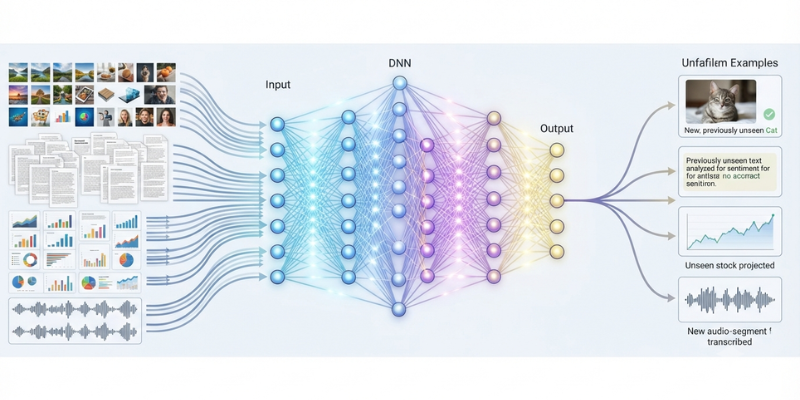
Deep learning is a strong field within artificial intelligence that enables computers to identify images, comprehend language, and tackle intricate problems. These systems learn by identifying patterns in large datasets instead of relying only on predefined rules. The effectiveness of a deep learning model is significantly influenced by the quality and amount of training data utilized. If you want to build a strong foundation in this field, consider exploring the Artificial Intelligence Course in Trivandrum at FITA Academy to understand how modern AI technologies learn from data.
How Deep Learning Models Learn From Data
Deep learning models use artificial neural networks inspired by the structure of the human brain. These networks contain multiple layers that process information and identify patterns. During training, the model examines examples, compares its predictions with the expected results, and adjusts its internal parameters to reduce errors.
For example, an image recognition model needs many images to learn the difference between cats and dogs. Each image provides useful information about shapes, colors, sizes, and other visual features. With enough varied examples, the model can learn patterns that help it classify new images more accurately.
Why Large Datasets Improve Model Accuracy
Large datasets expose deep learning models to a wider range of examples. This variety helps them recognize important patterns instead of memorizing a small set of training examples. When a model learns from diverse data, it has a better chance of performing well on information it has never seen before.
For instance, a speech recognition system trained on voices with different accents, speaking speeds, and background sounds can understand a wider range of speakers. However, more data does not automatically guarantee better results. The data must also be relevant, accurate, and representative of real-world situations.
The Role of Data Diversity in Deep Learning
Data diversity is just as important as data quantity. If a model learns from repetitive or limited examples, it may struggle when it encounters unfamiliar situations. Diverse datasets help models understand variations in the information they process.
Think about a facial recognition system that has been trained with images taken in various lighting situations, angles, and settings. These examples help the system recognize faces more reliably in everyday situations. Similarly, language models need different writing styles, sentence structures, and topics to understand how language is used in different contexts. If you’re interested in delving deeper into these ideas, consider the Artificial Intelligence Course in Kochi to strengthen your understanding of machine learning, data preparation, and deep learning fundamentals.
How Large Amounts of Data Help Prevent Overfitting
Overfitting happens when a model becomes too closely aligned with the training examples, resulting in poor performance on unfamiliar data. Instead of learning general patterns, the model may memorize details that are not useful beyond its training dataset.
Providing more varied training examples can reduce this problem by encouraging the model to learn broader patterns. Techniques such as data augmentation, regularization, and validation testing can also improve performance. Researchers use separate training, validation, and test datasets to evaluate how well a model learns and generalizes.
Still, dataset size should match the problem and model complexity. A carefully prepared smaller dataset can sometimes outperform a larger dataset filled with errors or irrelevant information.
The obstacles of training deep learning models with extensive datasets.
Working with large datasets requires significant computing power, memory, storage, and training time. Collecting and labeling data can also be expensive, especially when human experts must review each example.
Another challenge is data quality. Biased, outdated, or inaccurate information can lead to unreliable predictions, even when a dataset contains millions of examples. Developers must therefore balance dataset size with quality, diversity, privacy, and computational cost.
Approaches such as transfer learning and synthetic data generation can help reduce the amount of new data required for certain tasks. These methods allow developers to reuse existing knowledge or create additional training examples when suitable real-world data is limited.
Deep learning models typically require significant quantities of data since they understand intricate patterns through numerous instances. Sufficient, diverse, and high-quality data can improve accuracy, reduce overfitting, and help models perform better in unfamiliar situations. However, collecting more data is not always the best solution. Data quality, model design, training methods, and evaluation also influence the final results. If you are ready to strengthen your AI knowledge and explore practical learning opportunities, AI Courses in Gurgaon can be a useful starting point for building your understanding of artificial intelligence, machine learning, and deep learning concepts.